
Closed-cell and open-cell foam
Spray Foam Insulation in Reading, PA
Dense foam for tight, cold, damp spots; lighter foam where air sealing and sound matter more.
- Free on-site estimates
- Written quote with material, thickness and R-value for each area
- Wiring, chimneys and moisture checked before anything is covered
The Right Foam for Each Spot
Spray foam insulation goes on as a liquid, expands into every gap and cures in place, so one layer stops air and slows heat. In Reading, where more than half the homes are attached and much of the housing is very old, foam earns its cost in a few specific places: the shallow roof cavities of rowhomes, stone and brick foundations with wood sills on top, rim joists, kneewalls, and open walls during a renovation. In other places, like plaster walls and open attic floors, cellulose usually does as well for less.
Closed cell vs open cell
Closed-cell foam cures hard and dense. HomeGuide lists it at R-5 to R-7 per inch, and at normal thickness it slows vapor and does not soak up water. That makes it the go-to for shallow roof cavities, where every inch counts, and for foundations and sills, where cold surfaces meet damp basement air. Open-cell foam is softer and expands more, at R-3.5 to R-3.7 per inch. It seals air and quiets sound, but vapor passes through it, so in Zone 5 it needs a vapor retarder or a design that lets moisture dry.
Rowhome roofs
Many Reading rowhomes have a flat or low-slope roof with a cavity only a few inches to a foot deep between the top-floor ceiling and the roof deck. Getting a meaningful R-value into that space without trapping moisture is hard. Closed-cell foam against the underside of the roof deck reaches a useful R-value in a few inches, seals air leaks around the roof edge and cornice, and does not need a vent channel. Access is the main challenge: through the ceiling, through the roof edge, or during a roof replacement, when the deck is open from above.
Foundations and sills
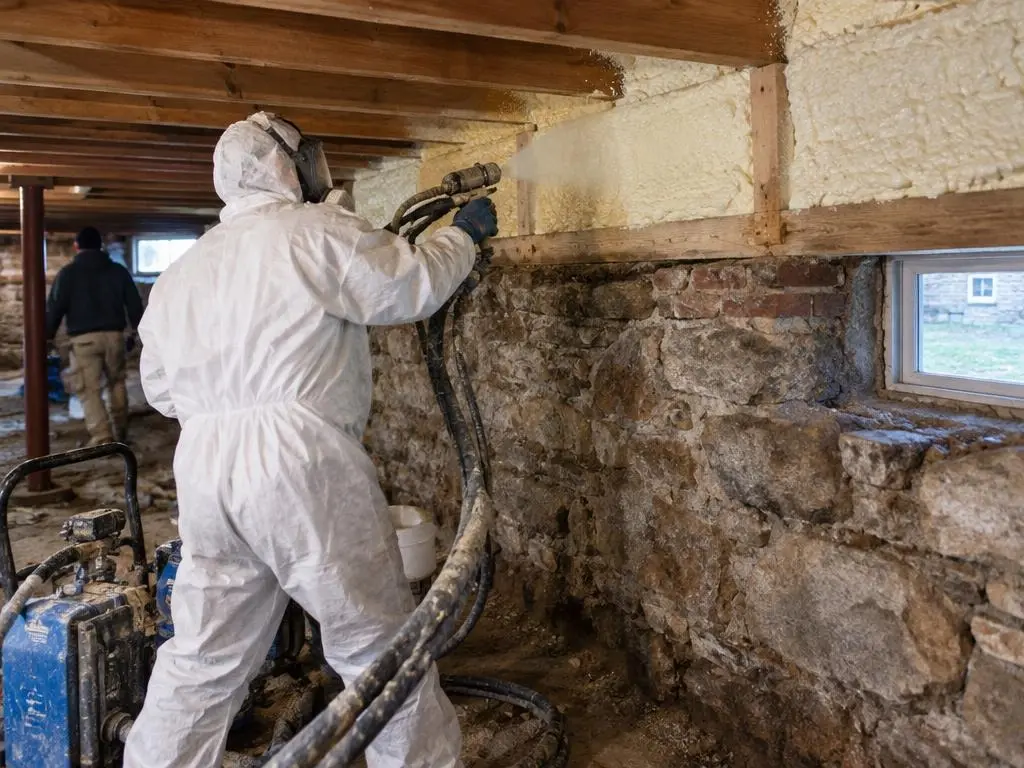
Old Reading foundations are often fieldstone or brick, with a wood sill on top and gaps all around. Closed-cell foam on the sill, rim and upper wall seals and insulates in one step. We check for dampness first and leave stone that needs to dry alone.
Open walls
During a gut renovation or addition, when stud bays are open, spray foam fills them completely. Open-cell works for many above-grade walls; closed-cell adds more R-value per inch where walls are thin.
Shared walls
Party walls between rowhomes do not lose much heat to the outside, since the neighbor's house is warm too. But gaps at the top and front and back of a party wall can leak air into the roof cavity. Foam seals those gaps.
When not to use foam
Foam should not go over live knob-and-tube wiring, untested vermiculite, wet wood or a leaking roof. It is also not the cheapest way to insulate an open attic floor. We tell you which parts of your house are worth foaming.
Curing
We cover, mask and ventilate. HomeGuide advises staying out for 24 hours or more while foam cures. In a rowhome, we also think about the neighbors and keep the work area closed off. Foam needs the surface and the material within a working temperature range, so cold spaces in winter may need added heat or a milder day. Get a free estimate
Where Foam Goes
The spots where foam earns its cost in Berks County houses.
Closed-cell foam
R-5 to R-7 per inch (HomeGuide) for roof cavities, foundations and sills.
Open-cell foam
R-3.5 to R-3.7 per inch for open walls and rooflines with a vapor plan.
Rowhome roof cavities
Closed-cell under the roof deck in shallow flat-roof spaces.
Sills and rim joists
Sealing where the house meets the stone or brick foundation.
Party wall gaps
Sealing air paths at the tops and ends of shared walls.
Open walls in renovations
Filling stud bays during a gut rehab or addition.
Published Spray Foam Costs
| Job | Range and source |
|---|---|
| Spray foam, installed | $1.50 to $5.00 per sq ft (HomeGuide) |
| Open-cell / closed-cell | $1.50 to $3.50 / $3.00 to $5.00 per sq ft (HomeGuide) |
| About 1,000 sq ft | $1,500 to $5,000 (HomeGuide); $3,150 to $7,500 existing home (Fixr) |
| Existing walls / new construction | $3.15 to $7.50 / $2.75 to $6.50 per sq ft (Fixr) |
| Attic | $3,000 to $8,000 (HomeGuide) |
| All exterior walls | $4,000 to $10,000 (HomeGuide) |
| Whole house | $8,000 to $20,000 (HomeGuide); $10,000 to $30,000 (Fixr) |
| Typical job minimum | $1,000 to $2,000+ (HomeGuide) |
National figures from HomeGuide (2026) and Fixr (2025). Foam type, thickness, access and prep set the total, and our written estimate is the price you pay.
How a Foam Job Runs
1. Inspect
Wiring, chimneys, vermiculite, moisture and access.
2. Quote
Foam type, thickness, R-value and price per area.
3. Prep
Cover, mask, ventilate and warm if needed.
4. Spray
Foam to the planned thickness.
5. Walk-through
Clean up and timing for re-entry.

Why Choose Us for Spray Foam Insulation
Foam where it fits
Cellulose where it does the job for less.
Rowhome know-how
Access to flat roofs planned up front.
Neighbors respected
Work contained in attached homes.
Spray Foam Insulation Questions
Can spray foam go in a flat roof cavity?
Yes, closed-cell foam against the roof deck is one of the best options for shallow flat-roof spaces. Access is planned case by case.
Is closed-cell or open-cell better for a stone basement?
Closed-cell on the sill, rim and dry upper wall.
How long should I stay out after spraying?
HomeGuide advises 24 hours or more. We confirm for your job.
Does spray foam bother the neighbors in a rowhome?
We keep the work area closed off and ventilated to the outside.

Spray Foam Insulation Service Areas
- Spray Foam Insulation in Reading, PA
- Spray Foam Insulation in Wyomissing, PA
- Spray Foam Insulation in West Reading, PA
- Spray Foam Insulation in Shillington, PA
- Spray Foam Insulation in Sinking Spring, PA
- Spray Foam Insulation in Spring Township, PA
- Spray Foam Insulation in Exeter Township, PA
- Spray Foam Insulation in Muhlenberg Township, PA
- Spray Foam Insulation in Cumru Township, PA
- Spray Foam Insulation in Mount Penn, PA
- Spray Foam Insulation in Kenhorst, PA
- Spray Foam Insulation in Laureldale, PA
- Spray Foam Insulation in Wernersville, PA
- Spray Foam Insulation in Birdsboro, PA
- Spray Foam Insulation in Kutztown, PA
Get a Spray Foam Insulation Estimate
Tell us about the house. We will look and send a written plan and price.