
Warmer floors from below
Basement & Foundation Insulation in Reading, PA
Seal the line where the house sits on its old foundation.
- Free on-site estimates
- Written quote with material, thickness and R-value for each area
- Wiring, chimneys and moisture checked before anything is covered
Where the House Meets the Stone
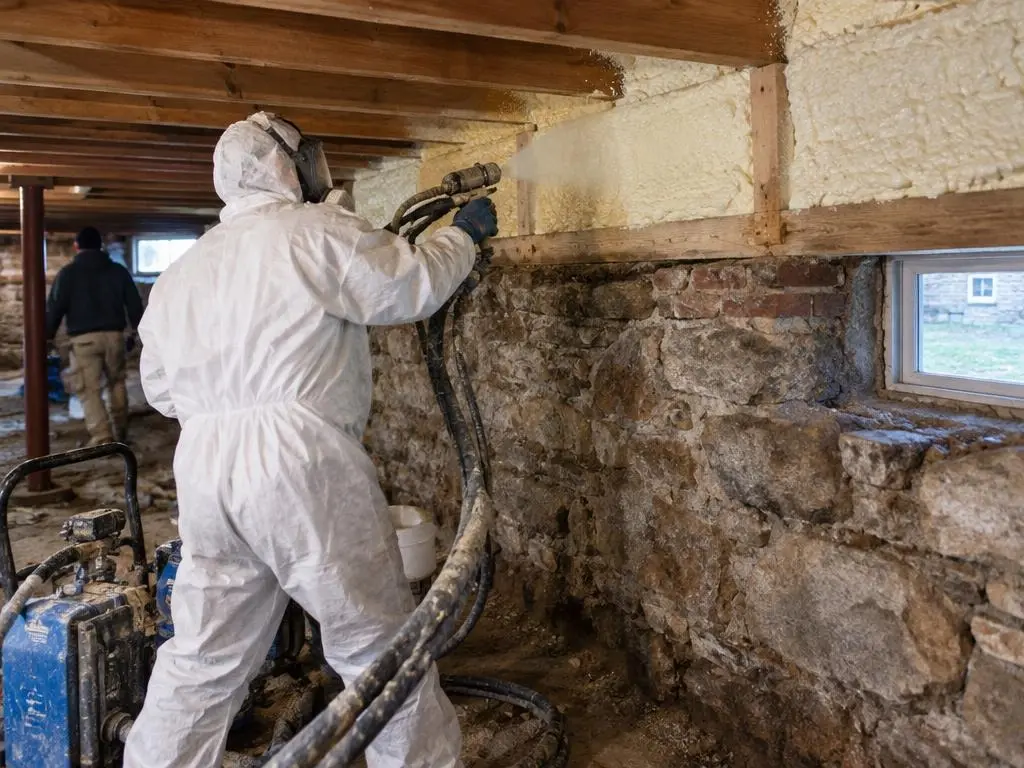
Basement and foundation insulation targets the line where a Reading house sits on its foundation. In older homes, that is usually a wood sill resting on fieldstone or brick. The joints between stone and sill, sill and rim, and around every pipe and wire are full of gaps, and cold air comes in all winter. The first floor stays cold and pipes near the wall can freeze.
Closed-cell foam
Two to three inches of closed-cell foam, at R-5 to R-7 per inch per HomeGuide, seals and insulates the sill and rim in one step. It does not absorb water and keeps warm air off cold wood. HomeGuide puts a typical rim joist foam job at $2,000 to $2,500.
Stone walls need to dry
Old stone foundations let some moisture through and need to dry. We usually foam the sill, rim and upper wall, which loses the most heat, and leave lower stone alone unless it is dry. If water is coming in, it gets fixed first.
Floods and wet basements
Wikipedia notes that the lower precincts of Reading along the Schuylkill have been inundated repeatedly, including by Hurricane Agnes in 1972 and a smaller flood in June 2006. Basements near the river or near creeks like Wyomissing Creek may have moisture history. Insulation that got wet should come out.
Limestone and sinkholes
Parts of Berks County sit on limestone. Sinking Spring is named for a spring that sank into the ground, and the borough has many underground streams that have formed sinkholes. Ground movement can crack foundations and open new air paths at the sill. We seal those gaps; structural cracks need a structural repair first.
Rowhome basements
Rowhome basements are narrow, with shared walls on each side. Only the front and back walls and their sills face the outside. Foaming those sills and rims is quick and makes a real difference on the first floor.
Code targets
PHRC lists R-10 continuous or R-13 cavity insulation for basement walls in the Central zone. For existing homes it is a guide.
What a basement visit looks like
We walk the basement with a light, following the sill and rim along every exterior wall and checking each place a pipe, wire, vent or old coal chute passes through. We look for daylight, moving cobwebs, staining, efflorescence and damp stone. Then we measure the rim length and wall height and write up which areas get foam, how thick, and what we leave alone so the stone can dry.
Fire barriers
Foam in a basement used as living space usually needs a thermal barrier like drywall. We explain what applies. Get a free estimate
What We Insulate Below
The base of the house.
Sills
Foam over the wood sill on stone or brick.
Rim joists
Foam in every bay along the exterior walls.
Upper foundation walls
Foam on the part of the wall that loses the most heat.
Crack sealing at the sill line
Closing gaps from settling.
Pipe and vent penetrations
Sealed through the rim.
Published Basement Costs
| Job | Range and source |
|---|---|
| Rim joists, spray foam | $2,000 to $2,500 (HomeGuide) |
| Closed-cell, installed | $3.00 to $5.00 per sq ft (HomeGuide) |
| Crawl space, spray foam | $2,000 to $4,000 (HomeGuide); $1,000 to $5,900 (Fixr) |
| Crawl space encapsulation | $3 to $10 per sq ft, $3,000 to $15,000 (HomeGuide) |
| Crawl space vapor barrier | $1,200 to $4,000 (HomeGuide) |
| Closed-cell on crawl space walls | $2 to $5 per sq ft (HomeGuide) |
Ranges are from HomeGuide (2026) and Fixr (2025). Rim length, wall condition and moisture work change the total, and the written estimate is what you pay.
How a Basement Job Runs
1. Moisture check
Look for water and damp stone.
2. Measure
Rim length and wall area.
3. Quote
Foam thickness and price.
4. Spray
Sill, rim and upper wall.
5. Walk-through
Show you the work.

Why Choose Us for Basement & Foundation Insulation
Stone-wall care
We know when to let stone dry.
Moisture first
No foam over active leaks.
Rowhome-sized jobs
Front and back sills done quickly.
Basement & Foundation Insulation Questions
Can you foam a fieldstone basement?
The sill, rim and dry upper wall. Lower stone often needs to dry.
Will foaming the sill warm my floors?
Usually noticeably.
Can you insulate a basement that flooded?
After it is dry and the water source is handled.
How long does it take?
Usually a day, less for a rowhome.
Can you seal an old coal chute or basement window?
We seal around frames and openings. Broken or rotted windows need repair first.

Basement & Foundation Insulation Service Areas
- Spray Foam Insulation in Reading, PA
- Spray Foam Insulation in Wyomissing, PA
- Spray Foam Insulation in West Reading, PA
- Spray Foam Insulation in Shillington, PA
- Spray Foam Insulation in Sinking Spring, PA
- Spray Foam Insulation in Spring Township, PA
- Spray Foam Insulation in Exeter Township, PA
- Spray Foam Insulation in Muhlenberg Township, PA
- Spray Foam Insulation in Cumru Township, PA
- Spray Foam Insulation in Mount Penn, PA
- Spray Foam Insulation in Kenhorst, PA
- Spray Foam Insulation in Laureldale, PA
- Spray Foam Insulation in Wernersville, PA
- Spray Foam Insulation in Birdsboro, PA
- Spray Foam Insulation in Kutztown, PA
Get a Basement & Foundation Insulation Estimate
Tell us about cold floors or a damp basement. We will measure and quote.