
Reading, West Reading, Wyomissing and Berks County
Spray Foam Insulation in Reading, PA
Rowhome roofs, stone foundations and old walls: we seal the leaks, insulate what matters and price it all in writing.
- Free on-site estimates
- Written quote with material, thickness and R-value for each area
- Wiring, chimneys and moisture checked before anything is covered
Rowhomes, Twins and Old Stone
Spray foam insulation in Reading has a very particular housing stock to work with. Census estimates compiled by Point2Homes count 52.2% of Reading's homes as single-family attached houses, mostly rowhomes, and only 11.8% as detached. Just 1.6% of the city's housing was built from 2000 to 2009 and 1.4% from 2010 to 2019. We seal and insulate those houses, using closed-cell or open-cell spray foam where it fits and blown or dense-packed cellulose where it does the job for less.
Reading's climate
Wikipedia places Reading on the southern edge of the hot-summer humid continental climate. Summers are warm and humid, with average July highs around 86.5F and about 27 days a year above 90F. Winters are cold enough to matter: January's average low is about 23F, and the record is -20F, set in January 1994. Snowfall averages around 25 inches, and the year's total precipitation is about 45 inches. A Reading house has to hold heat in winter and keep it out in summer, and a rowhome's roof takes the brunt of both.
How rowhomes lose heat
In a rowhome, the side walls are shared with neighbors, so most heat moves through the roof, the front and back walls, and the basement. Many Reading rowhomes have flat or low-slope roofs with a shallow cavity between the top-floor ceiling and the roof deck, often with little or no insulation. That is why third floors are so hot in July and drafty in January. Closed-cell foam reaches a useful R-value in a shallow cavity and seals air at the same time, which makes it one of the few practical options for those roofs. Down below, the wood sill on a stone or brick foundation leaks cold air around the whole perimeter.
Pennsylvania code and climate zone
Pennsylvania's 2021 Uniform Construction Code took effect statewide on January 1, 2026. Penn State's PHRC places Berks County in Pennsylvania's Central climate zone (its South zone covers Philadelphia and nearby counties), and OpenEI lists Berks in Zone 5A. PHRC's Pennsylvania Alternative Residential Energy Provisions list R-49 ceilings and R-20 (or R-13 plus R-5) walls for the Central zone. For an existing attic, the Department of Energy recommends R-60 in Zone 5 if it is uninsulated, or adding R-49 where 3 to 4 inches are already in place.
Closed cell vs open cell
Closed-cell foam is dense and rigid, about R-5 to R-7 per inch according to HomeGuide, and at normal thickness it slows vapor and does not absorb water. It suits shallow roof cavities, stone and brick foundations, sills and rim joists. Open-cell foam is lighter, about R-3.5 to R-3.7 per inch, seals air well and dampens sound, but vapor passes through it, so it needs a moisture plan. In plaster walls we usually dense-pack cellulose instead, because it fills around old framing through small holes and lets the wall dry.
Spray foam insulation contractors: what to ask
When you get quotes from spray foam insulation contractors or insulation companies around Reading, ask each one the same things. What will they seal first? Which material goes where, at what thickness and R-value? How will they reach a flat rowhome roof cavity? What about shared walls and the neighbors? How long should you stay out while foam cures (HomeGuide suggests 24 hours or more)? We answer in writing, area by area.
Spray foam insulation cost
HomeGuide's 2026 guide lists installed spray foam at $1.50 to $5.00 per square foot, with open-cell at $1.50 to $3.50 and closed-cell at $3.00 to $5.00. Spray foam on a roof deck runs $1,500 to $9,000, a rim joist job about $2,000 to $2,500 and dense-pack cellulose $1.60 to $4.20 per square foot. A rowhome's small footprint keeps some jobs modest, but access to a flat roof cavity can add cost. We price your house after seeing it, and the written estimate is the price.
Utility programs
Met-Ed serves much of Berks County. FirstEnergy's Pennsylvania weatherization rebate form for Met-Ed and its sister utilities covered insulation and air sealing installed between June 1, 2021 and March 31, 2026, with rebates of $150 to $500 based on energy savings and a participating-contractor audit. That program period has ended, so check FirstEnergy's current Pennsylvania offerings before you schedule, and keep your invoice. Get a free estimate
Our Work
Six kinds of work for Berks County buildings, from a rowhome's shallow roof cavity to the stone foundation and the pole barn out back.
Spray Foam Insulation
Closed-cell and open-cell foam that seals air and insulates in one layer, for roof cavities, foundations, sills and open walls.
Learn more →Rowhome Roof & Attic Insulation
Insulating the shallow roof cavities of rowhomes and the attics of twins and singles, with air sealing first.
Learn more →Basement & Foundation Insulation
Closed-cell foam on the sill, rim joist and upper walls of stone and brick foundations.
Learn more →Wall Insulation
Dense-pack cellulose in closed walls through small holes, and spray foam in open walls during renovations.
Learn more →Pole Barn & Farm Building Insulation
Closed-cell spray foam for pole barns, shops, bank barns and farm buildings across Berks County.
Learn more →Insulation Removal & Replacement
Removing wet, soiled or unsafe insulation, testing vermiculite first, then re-insulating.
Learn more →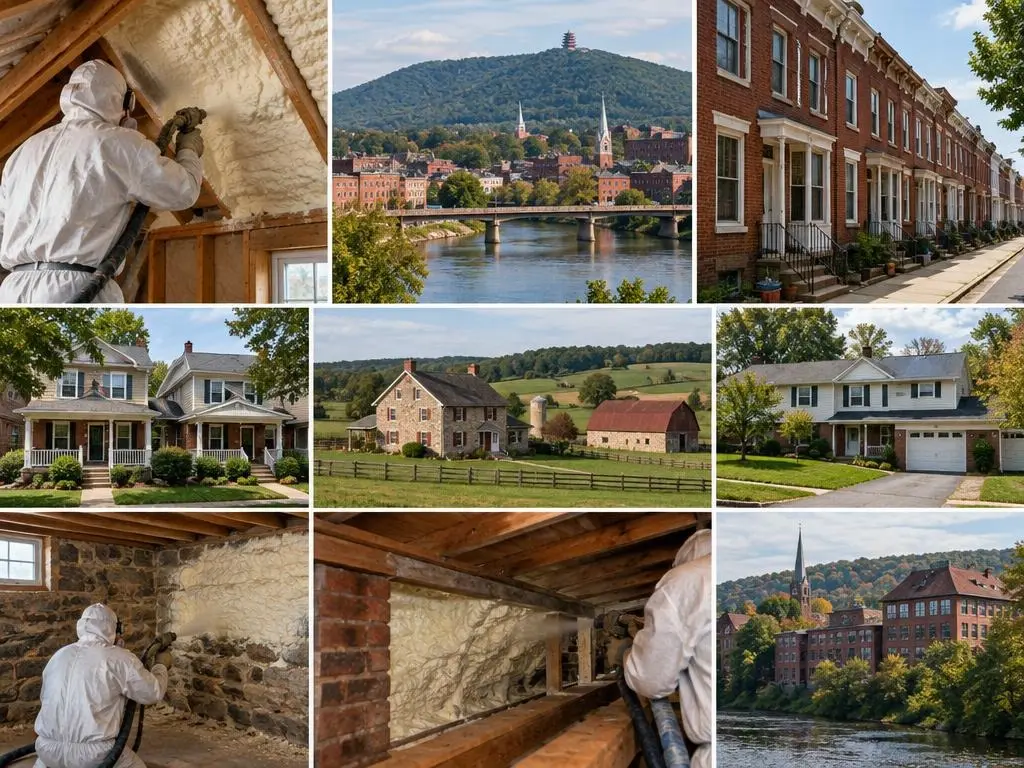
Common Questions
What is the highest R-value for spray foam insulation?
Closed-cell foam, at about R-5 to R-7 per inch according to HomeGuide. Open-cell is about R-3.5 to R-3.7 per inch. That is why closed-cell is used in shallow spaces like rowhome roof cavities.
Can you spray foam inside existing walls?
Injection foams exist, but in older Reading walls we usually dense-pack cellulose through small holes instead. It costs less, fills around old framing and lets the wall dry. Open walls during a remodel are where spray foam fits best.
Does spray foam insulation stop mold?
Foam that keeps warm, damp air off cold surfaces reduces condensation, which is what feeds mold. It does not fix leaks or remove existing mold, so leaks get fixed and mold gets cleaned first.
Who manufactures spray foam insulation?
Several large chemical and building-product companies make spray foam systems. What matters more is that the installer uses the right foam for each spot, at the right thickness, and lets it cure properly.
How do you insulate a rowhome with a flat roof?
Usually by reaching the shallow cavity between the top-floor ceiling and the roof deck, through the ceiling, the roof edge or during a roof replacement, and filling it with closed-cell foam or dense-packed cellulose. We look first and explain the options.
What R-value should a Reading attic have?
PHRC lists R-49 ceilings for Pennsylvania's Central zone, which includes Berks County, and the Department of Energy recommends R-60 for an uninsulated Zone 5 attic. Rowhome roof cavities often cannot reach those numbers, so we get as close as the space allows.
Why Homeowners Call Spray Foam Insulation Reading
Rowhome experience
Flat roofs, shallow cavities, shared walls and narrow basements are what we see every week.
Safety checks first
Knob-and-tube wiring, chimneys and vermiculite get checked before anything is covered.
Seal, then insulate
Sills, rims, chases and roof edges get sealed first.
Itemized quotes
Each area lists material, thickness or depth, target R-value and price.

Berks County Towns We Serve
We work in Reading and the boroughs around it: West Reading, Wyomissing, Shillington, Kenhorst, Mount Penn, Laureldale, Sinking Spring, Wernersville, Birdsboro and Kutztown, and in Spring, Cumru, Exeter and Muhlenberg townships. The city and the inner boroughs have the oldest, most attached housing. Wyomissing, Spring and Exeter have more 1970s to 1990s singles. Kutztown and the north have older borough homes and farm buildings. Each town page covers what is different there.
- Spray Foam Insulation in Reading, PA
- Spray Foam Insulation in Wyomissing, PA
- Spray Foam Insulation in West Reading, PA
- Spray Foam Insulation in Shillington, PA
- Spray Foam Insulation in Sinking Spring, PA
- Spray Foam Insulation in Spring Township, PA
- Spray Foam Insulation in Exeter Township, PA
- Spray Foam Insulation in Muhlenberg Township, PA
- Spray Foam Insulation in Cumru Township, PA
- Spray Foam Insulation in Mount Penn, PA
- Spray Foam Insulation in Kenhorst, PA
- Spray Foam Insulation in Laureldale, PA
- Spray Foam Insulation in Wernersville, PA
- Spray Foam Insulation in Birdsboro, PA
- Spray Foam Insulation in Kutztown, PA
Get a Written Insulation Quote
We look at the roof cavity or attic, the basement and the walls, then send a written price for each area.